
HISTORY OF THE FACTORY
1754-1776 Josiah Spode I works as a journeyman and rents various premises making creamware, blue painted earthenware, caneware, basalt and redware.
1776 Spode I buys factory site with sons Josiah II and Samuel in charge until the Mountford agreement ends.
1778 Spode II moves to London, taking premises 29 Fore Street and becomes a member of the Spectacle Makers’ Company, to enable him to trade.
1784 The art of underglaze blue printing mastered by Spode I. William Copeland employed by Spode II in London.
1785-1789 London business thrives, moving to ever larger premises.
1796 Champion’s Patent for true porcelain expires. Spode I is ready with English China. An invoice to William Tatton proves that some form of china had been made and marketed by this year. No. 5 Portugal Street acquired.
1797 William Taylor Copeland born; Josiah Spode I dies. Spode II then returns to Stoke.
1800 Bone china went into production.
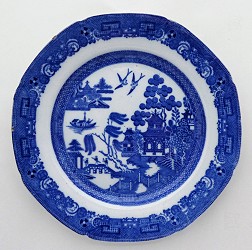
Willow First c.1795.
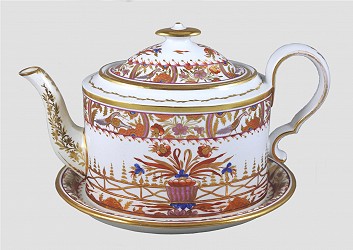
Bone china Old Oval shape teapot and stand , pattern number 498, c.1803

Felspar mark bat printed in puce colour, c.1821
1802 Boulton and Watt 10 HP rotative steam engine installed. Spode III loses an arm in an accident whilst inspecting it and retires.
1805 William Spode and William Copeland become equal partners in the London business. Henry Daniel sets up a decorating department to contract to Spode.
1806 The Prince of Wales appoints Josiah Spode “Potter and English Porcelain Manufacturer to His Royal Highness” following his visit to the factory in September.
1813 Stone China body developed to create replacements for Chinese porcelain.
1821 Felspar porcelain introduced.
1822 New Stone introduced. Henry Daniel leaves to set up his own factory. Underglaze transfer printing in colours other than blue introduced, identified in the B Series Pattern Book.
1824 William Taylor Copeland joins the London partnership; becomes a member of the Goldsmiths’ Company.
1826 W. T. Copeland forms a new partnership with Spode II to run for 7 years.
1827 Spode II dies forcing Spode III out of retirement.
1829 Spode III dies. Son Spode IV is only 6 years old. Factory is run by workforce and administered by executors of Spode’s will until 1833.

Bone china dish Pluck and Dust printed with Bamboo pattern, number 1185, 22cm square, having Spode Prince of Wales feathers mark of 1806 printed in red.

Felspar porcelain Gadroon shape plate bearing the arms of Clarke of Handsworth, 25cm diameter, c.1825

Stone china four-lobed dessert dish of squarish shape hand painted with Ship pattern, 19cm square, c. 1821.
1833 W. T. Copeland buys the factory, London business and other property from the executors. Commitments keep him in London so Thomas Garrett oversees the factory as a partner.
1835 Aged 38, W. T. Copeland becomes Lord Mayor of London. Hudsons’ Bay Company accepts Copeland and Garretts tender to supply china and earthenware.
1842 Forerunner of Parian introduced.
1845 Parian, as Statuary Porcelain, exhibited at Manchester.
1847 Parian figures produced for Art Unions. London business moved to New Bond Street.
1851 The firm displays at all major international exhibitions.
1867 Flower painting by C. F. Hűrten wins prizes at exhibitions. The firm becomes W. T. Copeland & Sons.
1868 W. T. Copeland dies and sons (Richard Pirie, Alfred and William F. M.) continue the business.
1870 Impressed date marks begin. Majolica becomes popular. Large trade in catering and armorial wares.

Copeland Manufactory Showroom

Entrance to the Manufactory
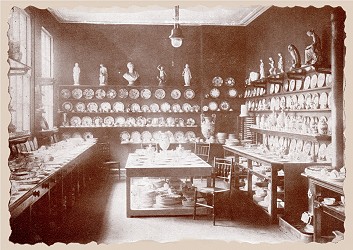
Copeland Sample Room

Parian twin scroll handled vase on foot, moulded in Renaissance style decoration and masked heads with glazed interior. Height 33cm, c.1870.

Bone china charger hand painted and signed by Charles Ferdinand Hűrten, 36cm diameter, c.1870.
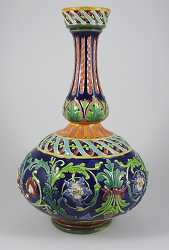
Majolica Milan shape bottle made of earthenware richly coloured and moulded. Height 26cm, c.1870
1902 Richard Ronald John, son of R. P. Copeland joins the firm. Alfred Gresham joins the following year.
1913 These sons assume control when Richard Pirie Copeland dies.
1923 Electricity introduced. Boulton and Watt beam engine removed.
1930 Art Deco designs introduced but did not prove popular with traditional clients.
1941 Utility wares introduced during World War II.
1946 Tunnel kilns gradually introduced.
1954 Murray Curvex machine installed.
1958 Ronald Copeland dies. Spencer and Robert are the only Copelands with links to the factory remaining.
1960 Duke of Edinburgh Design Award for Royal College shape. Designed by Neil French and David White.
1966 Company becomes part of Carborundum Group.

Royal Crocus glaze wares, 1930s.
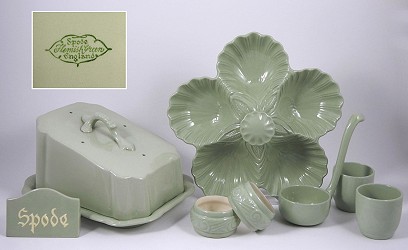
Plain Flemish Green wares, 1950s

Royal College shape, 1960s
1987 Museum Collection registered with Charity Commission as Spode Museum Trust.
2002 Richard Spencer Charles Copeland dies.
2008 Spode Limited goes into administration
2010 Thomas Robert Copeland dies.

Spode Vase hand painted by Liam Miller, artist in Spode's Prestige Department, 1980s

Bone china tea wares made at the Carborundum Museum of Ceramics at Niagara Falls c.1973

Spode bone china Vacuum Tureen, c.1960, 'Ambassador' which retailed at £38.15s.